The smell hits you first. Then you see it — dark water rising in a shower drain, pushing up out of a floor drain in the garage, or worse, coming back through a toilet that will not stop. A sewage backup is not a bad version of a normal flood. It is a different, more dangerous category of problem, and how you react in the first hour matters for your family's health, not just your floors.
People make it worse by treating it like clean water. They wade in to save a rug. They let the dog sniff around. They mop it up with towels and reuse them. Sewage water — what the industry calls Category 3, or black water — carries bacteria, viruses, and parasites that cause real illness. Here is what it is, why it is dangerous, and exactly what to do and not do.
What 'Category 3' black water actually means
Restoration pros sort water into three categories. Category 1 is clean water from a supply line. Category 2 is gray water with some contamination, like a washing-machine discharge. Category 3 is grossly contaminated — sewage, drain backups, and flood water that touched the ground. It can carry E. coli, hepatitis A, rotavirus, and other pathogens.
The category drives everything: what can be saved, what has to be thrown out, and how the space must be cleaned. Porous materials that soaked up black water — carpet, pad, drywall, particleboard — usually cannot be disinfected reliably and have to go. That is not an upsell; it is the IICRC standard, and it is what keeps your family from getting sick.
Immediate steps: keep people and pets out first
Your first job is containing people, not water.
- Get everyone — especially kids and pets — out of the affected area and keep them out. Close the door.
- Do not walk through it. If you must, and you have no protective gear, you are risking skin contact with pathogens.
- If sewage is near outlets or the panel and you can reach the breaker safely, cut power to the area. Never touch standing water and electrical together.
- Stop using water in the house. Every flush and every draining sink adds to the backup.
- Open windows for ventilation if the weather allows, but do not run the HVAC — it can spread contaminated aerosols through the ducts.
- Photograph everything for your insurance claim, from a safe distance.
Do and don't
The instinct to clean up fast is exactly what gets people sick with a sewage backup. Read this before you touch anything.
- Do keep the area sealed off and ventilated to the outside.
- Do call a professional sewage crew right away — this is time-sensitive.
- Do save receipts and document damaged items for your claim.
- Don't try to clean black water with household cleaners and a mop; you cannot disinfect a soaked carpet pad by wiping the surface.
- Don't put contaminated items back into use, and don't reuse rags or a home vacuum.
- Don't run fans across the contaminated area before extraction — you will aerosolize the bacteria.
Why older Tempe streets back up more
There is a reason certain Tempe neighborhoods see more sewage backups than others. Many of the older, tree-lined streets — the mature, established blocks in areas like Evergreen and the historic districts near ASU — sit over clay soil and aging sewer laterals. Big ficus, ash, and olive roots hunt for moisture and work their way into pipe joints, then grow into a mat that snags everything flushed until the line backs up into the lowest drain in the house.
Slab-on-grade homes make it worse, because the lowest drain is often a shower or floor drain inside the living space rather than a basement. When the city main or your lateral clogs, the backup has nowhere to go but up into the house. A plumber clears the blockage; a restoration crew handles the contaminated water and everything it touched.
Why this is a job for professionals with PPE
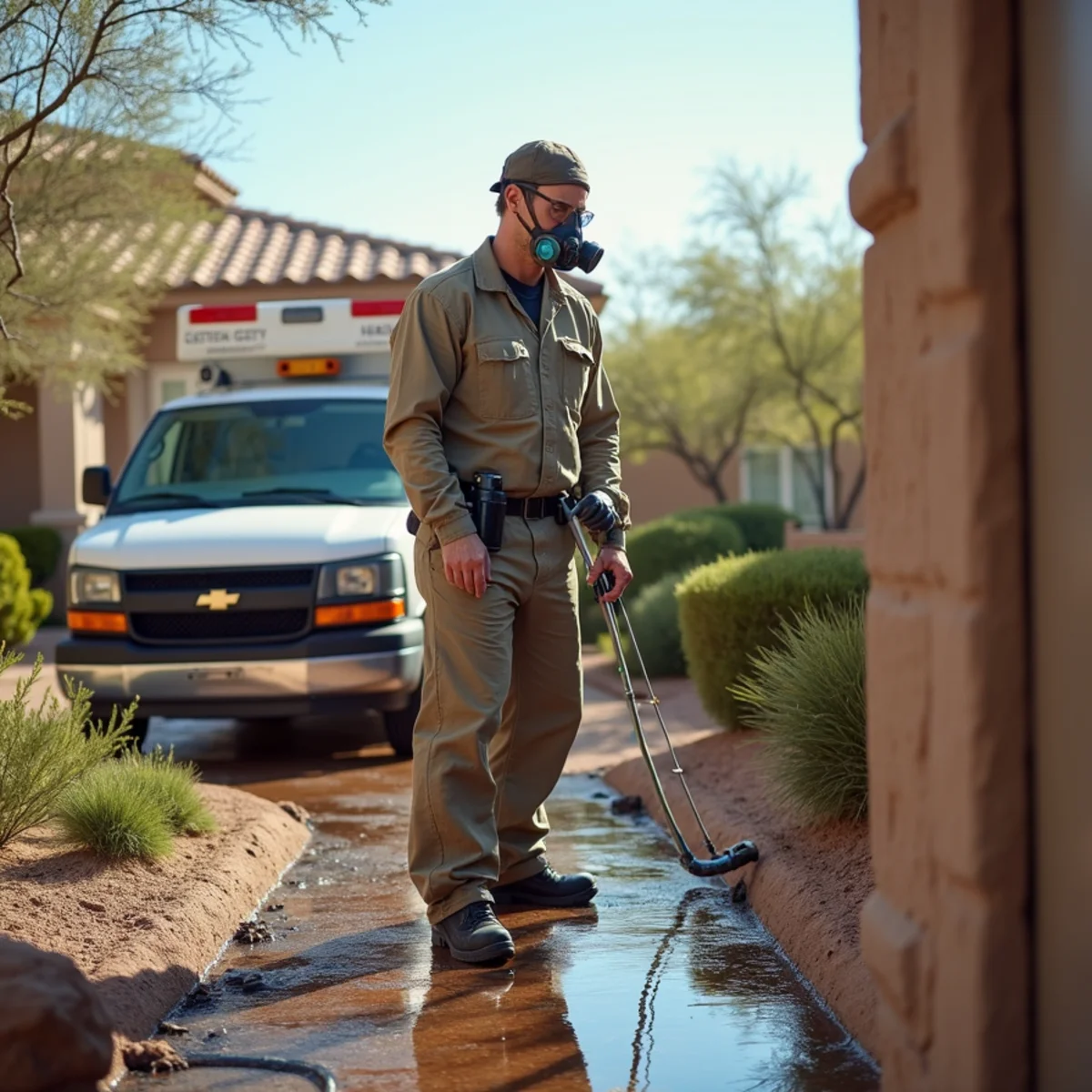
Sewage cleanup is not a DIY project, and it is one of the few water jobs where doing it yourself can genuinely harm you. Proper sewage backup emergency response means crews in protective suits, gloves, and respirators; extraction with equipment that is decontaminated afterward; removal and disposal of unsalvageable porous materials as biohazard; and antimicrobial treatment of everything that stays. Then structural drying, so the wet materials behind the visible mess do not grow mold on top of the bacteria problem.
Full professional sewage cleanup and sanitization also addresses the part most people miss — the lingering smell and the invisible contamination that stays behind after the water is gone. For how we knock out that odor for good, see our guide on the sewage smell and sanitization after a backup.
When to call
Now. The moment you identify a backup as sewage, stop cleaning and call. We answer the phone at 2 a.m., and our base off W Auto Dr keeps a crew close to Tempe's older neighborhoods where these backups cluster. We show up in the right gear, contain it properly, and give you an itemized estimate — not a scare tactic — for exactly what has to happen and why.
Frequently Asked Questions
Genuinely dangerous. Sewage is Category 3 black water carrying bacteria, viruses, and parasites like E. coli and hepatitis A. It can cause serious illness through skin contact or aerosols. Keep people and pets out, and leave cleanup to crews with proper protective equipment.
We don't recommend it. You cannot reliably disinfect porous materials like carpet, pad, and drywall once black water soaks in, and cleaning without protective gear risks your health. A professional crew removes what's unsalvageable, sanitizes the rest, and dries the structure.
In older tree-lined neighborhoods, roots invade aging sewer laterals and clog them until the line backs up into the lowest drain. A plumber clears the blockage; a restoration crew handles the contaminated water. If it recurs, have the lateral camera-inspected for root intrusion.
Often only if you carry a sewer or drain backup endorsement — standard policies frequently exclude it. Coverage varies, so document everything and check your policy. Emergency mitigation to protect health is time-sensitive regardless of the coverage question.
Need Help With This in Person?
Our local crew handles it 24/7. Explore the related services and areas below, or just call (866) 688-0301.