You planned on that water heater lasting a decade or more. The label said so. Then, sometime around year six or seven, you found a puddle spreading across the garage floor — or worse, a tank that let go all at once and sent forty gallons across the slab. If you live in Tempe, this is not bad luck. It is chemistry, and it is on a schedule.
Tempe's water is hard. Not a little hard — 16 to 21 grains per gallon, with parts of Scottsdale pushing 25. That mineral load is relentless on a water heater, and it is the single biggest reason tanks here fail years ahead of the national average. Here is exactly how it happens, and what you can do to slow it down.
What 'hard water' means in Tempe
Hardness is a measure of dissolved minerals, mostly calcium and magnesium, in your water. Anything above about 7 grains per gallon is considered hard. At 16 to 21 grains, Tempe water is very hard, and every gallon that flows into your water heater carries a dose of scale-forming minerals with it. Over a few years, that adds up to pounds of sediment sitting in the bottom of your tank.
How hard water actually destroys a water heater
The damage happens on two fronts, and understanding both is the key to seeing why these tanks fail early.
- Sediment buildup on the tank floor. As water heats, dissolved minerals precipitate out and settle as a hard crust of scale at the bottom of the tank. That layer insulates the water from the burner below, so the heater works harder and longer, overheating the steel and accelerating wear.
- Anode rod exhaustion. Every tank has a sacrificial anode rod designed to corrode instead of the tank walls. Hard, mineral-rich water eats through that rod far faster than soft water does. Once the rod is gone, the corrosion moves to the tank steel itself — and that is when leaks begin.
- Scale on the elements and valves. In electric units, scale coats the heating elements and burns them out. In gas and electric tanks alike, it fouls the temperature-and-pressure relief valve, the safety device meant to prevent a catastrophic rupture.
Warning signs your tank is on its way out
- Rumbling, popping, or crackling noises during a heating cycle.
- Rusty or cloudy hot water, or a metallic smell.
- Hot water that runs out faster than it used to — sediment is stealing tank capacity.
- Moisture, rust, or a mineral crust around the base or the fittings.
- A tank more than five or six years old that has never been flushed.
Why 6–7 years, not 10–12
Manufacturers rate tanks on water that is far softer than ours. In a soft-water region, with an annual flush and an anode-rod swap at the halfway mark, a tank can reach twelve years. In Tempe, an unmaintained tank fighting 16-to-21-grain water routinely gives out at six or seven. The warranty may still be valid; the tank is still dead. Hard water simply compresses the timeline.
When the tank finally lets go
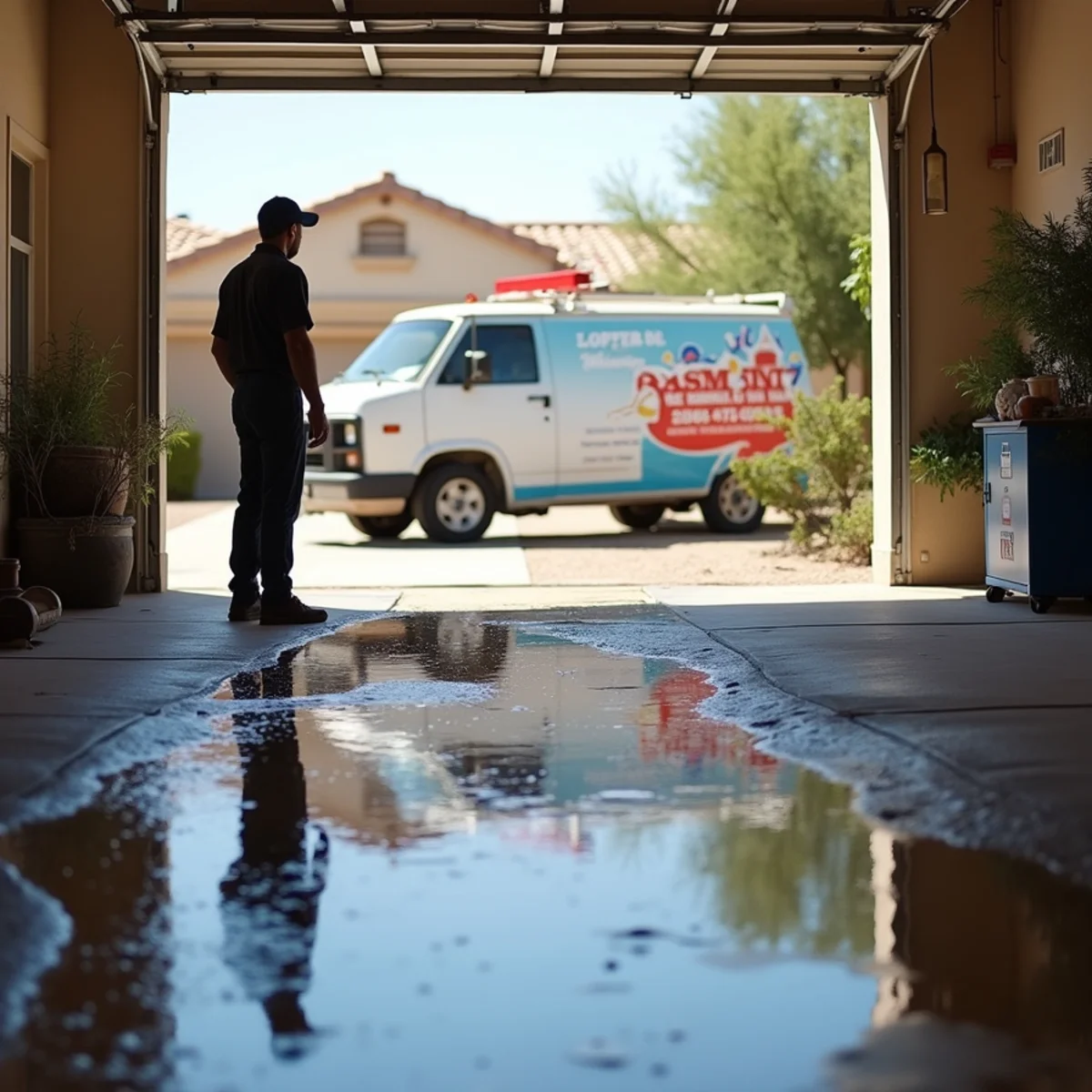
A water heater can fail two ways. A slow seep from a corroded fitting is the lucky version — you catch it, you mop, you replace the unit. The other version is a full tank rupture, where a rusted-through wall gives way and dumps the entire tank in minutes. In a garage, that water spreads to drywall, stored belongings, and often into the adjoining rooms. This is one of the most common calls we run, and we cover it under water heater burst cleanup. For the emergency steps to take in the moment, see our guide on what to do when a water heater bursts in the garage.
How to buy years back
You cannot change Tempe's water, but you can fight it. A few habits meaningfully extend a tank's life:
- Flush the tank on a schedule. In hard-water Tempe that means draining sediment every six months, not once a year. Our hard-water flush schedule guide lays out the timing.
- Check the anode rod every two to three years and replace it when it is more than half consumed. A cheap rod protects the whole tank.
- Consider a whole-home water softener. It is the most effective long-term defense, cutting the mineral load on the heater and every other appliance and fixture in the house.
- Know where your shut-off is. If the tank does let go, closing the cold-water supply valve on top stops the flood.
Even with perfect maintenance, hard water wins eventually — but the difference between a six-year tank and an eleven-year tank is real money and one fewer garage flood. And when a tank does fail, fast cleanup keeps a simple appliance swap from becoming a full water damage restoration project. We serve heaters that fail across Tempe and the surrounding East Valley; call (866) 688-0301 the moment you find water.
Frequently Asked Questions
With Tempe's 16–21 grain hard water and no maintenance, expect about six to seven years. With regular flushing, anode-rod checks, or a water softener, you can push a tank toward ten or eleven. The national ten-to-twelve-year figure assumes much softer water than we have here.
Yes — it is the single most effective step. By removing most of the calcium and magnesium before water reaches the tank, a softener dramatically slows sediment and anode-rod consumption, and it protects your faucets, dishwasher, and washing machine at the same time.
It can be. A minor drip gives you time to plan a replacement, but a corroded tank can progress to a full rupture without much warning. If you see active leaking, shut off the cold-water supply valve and the power or gas, and call us. We respond 24/7 across Tempe.
The sudden water damage from a ruptured tank is typically covered, though the failed heater itself usually is not. Documenting the damage and getting professional mitigation started quickly both help your claim. We provide the itemized paperwork insurers expect.
Need Help With This in Person?
Our local crew handles it 24/7. Explore the related services and areas below, or just call (866) 688-0301.